
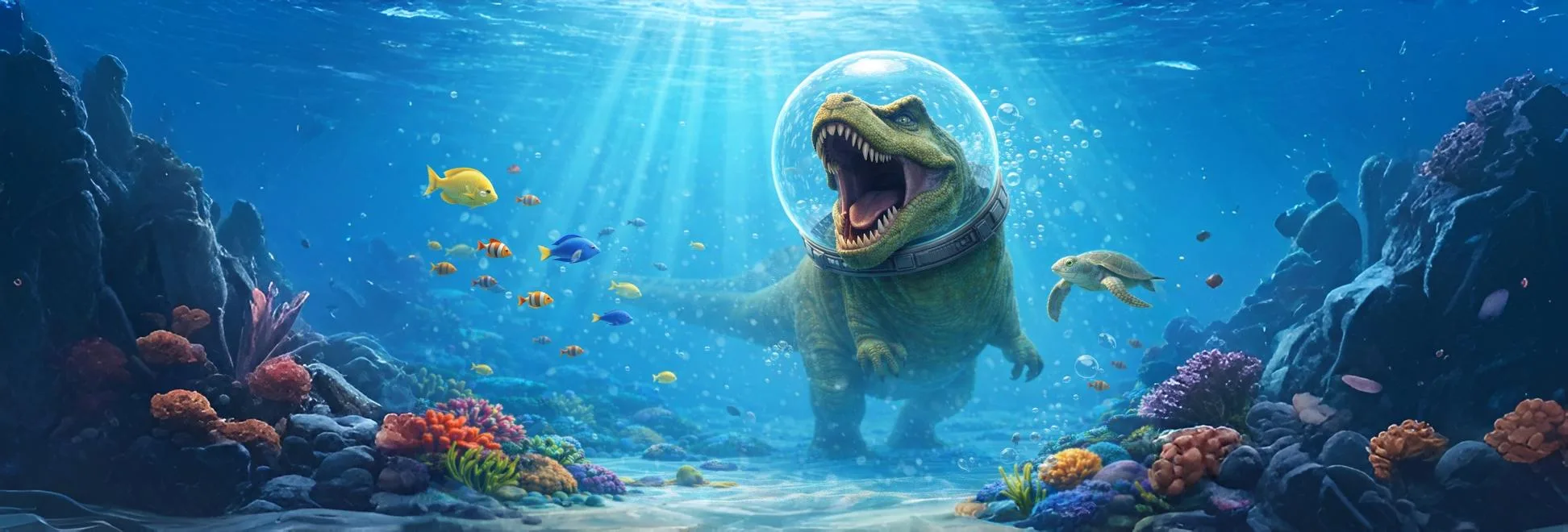
People talk about Tyrannosaurus rex like it belongs in a movie more than in real history.
Not because it looks strange, but because it feels too extreme to have actually existed. A walking pile of muscle with a head full of bone-crushing teeth sounds like something someone designed for shock value. Yet this animal walked around on Earth for millions of years, dealing with hunger, injuries, rivals, and the simple challenge of staying alive, just like everything else that ever lived here.
What makes T-rex so interesting is not just how terrifying it looks, but how often our understanding of it changes. Every few years, new discoveries quietly rewrite parts of its story.
Built to Finish Things
Its size is usually the first thing people mention, and for good reason. A fully grown T-rex could stretch longer than a bus and weigh as much as a heavy truck. The skull alone could tower over a human. Those famous teeth were thick and blunt in a way that tells you they were made for crushing, not slicing neatly. This wasn’t an animal built to wound and walk away. It was built to finish things.
The Scavenger vs. Hunter Myth
For a long time, there was a strange debate about whether T-rex was a hunter or a scavenger, as if it had to pick one identity and stick with it. Nature does not work that way. When hunting made sense, it hunted. When an easier meal appeared, it took advantage. That is not dishonorable or lazy. It is simply how survival works.
Social Dynamics and Rivalries
Another question people like asking is whether T-rex lived and hunted alone or with others. Most evidence points toward adults being solitary animals. When you reach that size and strength, cooperation is not really a necessity. Still, younger T-rex may have behaved differently. Some fossil sites show several individuals together, suggesting that at certain stages of life, they may not have been as independent as their older counterparts.
There is also clear evidence that T-rex did not only fight other species. Fossils show healed bite marks that could only have come from another T-rex. That means rivalry was real. Whether over territory, food, or mates, these animals were not always just dominant predators. Sometimes they were each other’s biggest threat.
The Question of Feathers
Then there is the feather question, which continues to surprise people.
Some of T-rex’s smaller relatives were definitely feathered, and for a while that made scientists rethink everything. For the large T-rex itself, skin fossils mostly show scales. Even so, many researchers believe young T-rex may have had some feathering for warmth before losing it as they grew larger. The idea of a slightly fluffy juvenile T-rex sounds odd, but it fits what we know about similar species.
Life Expectancy and Growth Spurts
Another surprising detail is how long T-rex may have lived. It was once assumed that such a massive animal burned out quickly, but newer studies suggest it could live for thirty years or more, possibly approaching forty. That is a long time for an animal built on that scale.
Its growth was unusual as well. Rather than growing steadily, T-rex spent many years developing slowly, followed by a rapid growth phase where it suddenly gained enormous size. It did not begin life as a giant. It grew into one, piece by piece.
T-Rex Wild Attack
It’s one thing to read about these giants, but it’s another thing entirely to see that power brought to life. We are not talking about the movie screen, but something more interactive, the reels! T-Rex Wild Attack, tries to capture that same “larger-than-life” energy we’ve been talking about. This game is a digital resurrection that leans into the chaos of the prehistoric world. You’ll be trading quiet museum halls for high-speed gameplay. The predator is used as a catalyst for the game’s biggest shifts, making the experience feel as unpredictable as a hunt in the Cretaceous.
- The Big Roar: The T-Rex acts as a Wild here, and if he lets out a roar, it triggers a “Cascade.” It’s a satisfying mechanic where the low-value filler symbols basically crumble away, making room for high-paying dinosaurs like Velociraptors and Pterosaurs to drop into the gap.
- Hatching the Bonus: Instead of just clicking a button, you’re looking for Dinosaur Egg symbols. If you land three or more, you “hatch” a round of free spins—up to 20 if you’re lucky—which is where the game’s momentum really picks up.
- The Survival Instinct: My favorite part is the Stacked Wilds. You might see a massive 1×4 T-Rex fill an entire reel. If you don’t win on that spin, the game gives you a re-spin where the multiplier actually grows. It keeps going until you hit a win, mimicking that “don’t give up” survival instinct.
- The Stakes: It’s a medium-volatility setup with 30 paylines, but the top prize is a massive 50,000 times the bet per line. It’s high-energy, a little bit tense, and a great way to step into a world that’s been gone for millions of years.
An Ecological Balance
A question that naturally follows is how a predator this large managed to survive without wiping out everything around it. The answer is not dramatic or mysterious. It is balance. Predators cannot exist without prey, and prey cannot disappear entirely without consequences. The fact that T-rex lived for millions of years shows that it fit into its environment rather than overwhelming it.
Some hunts failed and some days likely passed without a proper meal. Other predators competed for the same food. Plenty of prey fought back successfully.
All of that kept things in check.
A Real Animal in a Real World
That is what makes T-rex truly fascinating. Not just its power or appearance, but the fact that it was part of a complex, living system rather than a creature that dominated everything without limits.
It was not a legend or a monster while it was alive. It was simply an animal, perfectly shaped for its time, surviving in a world that no longer exists.
And in many ways, that reality is far more impressive than any movie version ever created.