
If you were to wonder what true rarity looks like, you would do well to forget about diamonds, limited-edition watches, or even famous paintings. True, the ultimate symbol of that luxury — the one even billionaires cannot easily buy — is a Fabergé Imperial Easter Egg, and for the first time in more than twenty years, one of the most extraordinary examples ever made was on auction this week. The legendary 1913 Winter Egg was sold for 22,9 million British pounds ( 30.2 million dollars) in London.
Only 50 Imperial eggs ever were made for the Russian tsars. The vast majority of them are locked up forever in museums, royal collections, or institutions. The remainder are relatively few in private hands. And according to experts, three are said to be still truly in “play,” one of those being this Winter Egg. It is probably the last time the world sees this egg being offered for sale.
A Treasure Almost No One Can Own
Fabergé made these eggs for the Tsars Alexander III and Nicholas II from the years 1885 to 1916 so they would have very lavish Easter gifts. From those 50, there are currently seven missing, the majority being permanently in museums. Very few belong to private collectors- an even smaller number of those would not dream of selling.
Therefore, it follows that the Winter Egg is causing all kinds of waves in the art world. Christie believes it will secure more than $26 million, smashing the record of that total back in 2002 when this same egg went for $9.6 million.
But Why Now? Why This Egg?
A masterpiece sculpted from ice
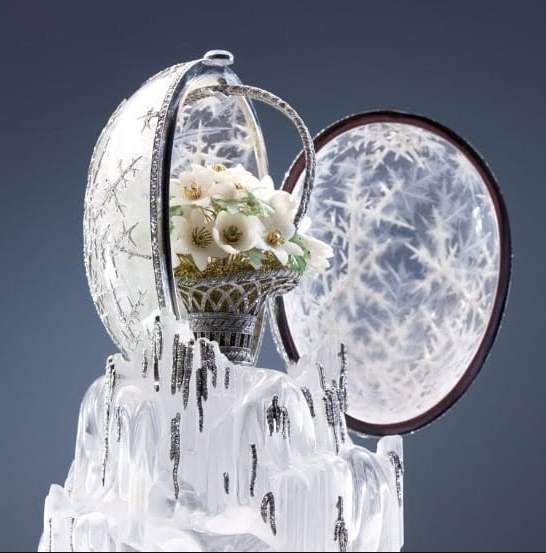
Unlike most of Fabergé’s eggs whose interiors are filled and decorated with gold, enamel, and gems, the Winter Egg stands apart in that it contains breathtaking artistry.
It looks like something sculpted straight from frozen air.
Made from a perfect block of clear rock crystal, the egg is decorated with patterns of “frost,” tiny engraved snowflakes, and icy textures, catching the light as if freshly fallen. More than 4,500 rose-cut diamonds sparkle under this surface not as garish stones but as glimmering “ice crystals.”
It is a miracle in quartz, according to collectors. Of one expert who held it, he said:
“Feels like holding a piece of winter itself.”
He finds a very delicate basket full of budding wood anemones—one of the first flowers to push through the thaw in Russia after winter—instead of a mechanical toy or a clockspring surprise. Each petal is carved from milky white quartz. Each stem is made from green jade. Even the centers of the flowers glow with tiny garnets.
Nature frozen in time.
A Secret Made by a Woman in a Man’s World
This is something that most casual Fabergé fans do not really know: the Winter Egg was designed by a woman — Alma Pihl.
Such was almost unheard of in the male-dominated jewelry world of pre-revolutionary Russia. She was a young artist working in the workshop of her uncle, Fabergé’s chief jeweler. One day she gazed out the window and saw frost form on the face of the glass. And she thought:
How do you capture that moment—that delicate frost—in jewelry?
The Winter Egg was the answer. Today, her design is hailed as one of the most brilliant and original creations Fabergé ever produced.
A Journey Through Revolutions, Mysteries, and Lost Time
After Tsar Nicholas II presented the egg to his mother that very gift in the year 1913, events in the world proceeded to move very quickly, as within a year, world war I broke out and shortly afterward came about the collapse of the Russian Empire, the shooting of the tsar, and the commencement of selling royal wonders by the soviet government to realize cash.
Masterpieces shifted into private hands. The Winter Egg was sold for only 450 pounds in the 1920s—an almost astounding amount when considered today.
Then it was gone. For almost two decades, experts had no idea where it was. Some dreaded it might never be found.
Reappeared in 1994, sold at Christie’s, Geneva, then to New York, in 2002—and now, once again, in 2025.
Why It’s Next to Impossible to Hazard a Guess for Its Buyer.
In earlier years, the U.S. and Russia were the premier markets for Fabergé art. But today?
The U.S. has extremely high-pressured duties over art importation.
Luxury purchases are severely restricted due to the numerous sanctions imposed on Russia.
Rumors about the likelihood that a work could be returned to Russia would immediately negate any deal on the auction house’s end.
So who was able to buy it?
Middle Eastern museums or Private buyers in Asia might have been one of the buys. Whoever bought it stayed anonymous and so it’s anyone’s guess at this point.
Why the Winter Egg Matters
This isn’t just another luxury collectible; it is really a piece of history that survived revolution, war, political upheaval, disappearance, rediscovery, and the collapse of empires.
It is:
- the high point of craftsmanship just before the First World War
- the end-of-an-era Imperial Russia
- one of the most unique designs that Fabergé ever created
- an artwork for which there are no real modern counterparts
And because so many Imperial eggs are locked away forever, the Winter Egg might well vanish once again soon — this time into a vault, so that the public will never see it again.
Final Thoughts
Fabergé eggs belong to that rare class of art where beauty, history, and myth all weave together. The Winter Egg holds its own at the very top of that world—a masterpiece one finds only once in a century, made of ice, light, and imagination.
Would you like to have one of these eggs as a collectible or would it serve as a way to get instant funds by selling it? Let Mr. Yabby know!