

Mr. Yabby has explored the crypto world yet again has lots of interesting things to share! Ocean dwellers gather in suspense, waiting with bated breath on what he has to say. The stage lights start to shine he appears in front of the ocean crowd and starts talking.
Tether’s Expansive Investment Empire
Tether, best known for issuing the world’s largest stablecoin, has quietly evolved into one of the most wide-reaching financial conglomerates in the crypto space. While most people associate the company solely with USDT, its influence now stretches across more than 120 companies spanning artificial intelligence, payment processing, satellite technology, video streaming, BTC mining, and even sports. Only a small portion of these—24 investments—are listed on the public “Tether Ventures” page, leaving much of its portfolio visible only through interviews, archived pages, and scattered public disclosures.
Some investments have even disappeared from Tether’s official listings, such as OrionX, a Chilean exchange once highlighted by Tether but later removed without explanation. This lack of transparency has led to growing curiosity about the full extent of Tether’s corporate reach.
A Pattern Emerges
One of the most notable patterns in Tether’s investment strategy is its repeated support of companies connected to industry figure Samson Mow. Tether has backed Exordium, the publisher behind the game Infinite Fleet, as well as Jan3, which aims to promote Bitcoin adoption through wallets and infrastructure. Blockstream, where Mow previously served as CSO, has also received funding from iFinex, the sister company to Tether.
Not all of Tether’s investments have gone well. The company was a prominent equity investor in Celsius, the now-collapsed lending platform whose founder was recently sentenced to 12 years in prison. Tether’s involvement became a major point of contention during the Celsius bankruptcy proceedings, eventually ending in a nearly $300 million settlement.
At the same time, Tether has pushed aggressively into Bitcoin mining, backing initiatives in El Salvador and Uruguay, though not all of these projects have reached operational success. It has invested in satellite company Satellogic, energy ventures such as Proton Management, and fintech platforms like Parfin and Ledn, showcasing its ambition to influence multiple layers of the global digital-asset ecosystem.
Tether’s sprawling investment footprint reveals a company positioning itself far beyond stablecoins—aiming instead to become a dominant force shaping the future of crypto infrastructure, financial technology, and digital innovation worldwide.
Yabby’s Welcome

Here, in the endless blue of Yabby casino there are numerous and unique games to explore. If you are looking to begin your voyage and test out the waters first, without having to invest we have just the thing! Mr. Yabby’s Welcome Bonus lets you do just that. You can choose between 200 Free Spins and a $200 Chip. It’s a free bonus that gives you a chance to test out the games while you also have a chance to win something.
How it works:
- Offer valid for new players only and can be claimed once per account.
- Can be used only as the very first action on one’s account.
- Maximum cashout: $50.
- Eligible games: non-progressive slots (777 excluded).
- Limited to one use per player, IP, and household.
- Standard terms and conditions apply.
Crypto’s Expanding Footprint in Formula 1
As the 2025 Formula 1 season races toward its finale in Abu Dhabi, one trend has stood out all year long: the strong presence of crypto brands across the grid. This season featured 12 crypto-related sponsorships, ranging from exchanges and NFT companies to crypto casinos. Their logos have been visible on cars, suits, helmets, and paddock screens throughout the year.
Kick Sauber led the pack in this category. The team partnered with CoinPayments, Stake, Libertex, and LBX, giving it the highest number of crypto sponsors in the sport. Major industry players followed closely. Binance backed Alpine. Kraken partnered with Williams. Coinbase supported Aston Martin. OKX continued its high-profile collaboration with McLaren.
These partnerships mark a growing alignment between motorsport and digital finance.
The Business Behind Crypto–F1 Partnerships
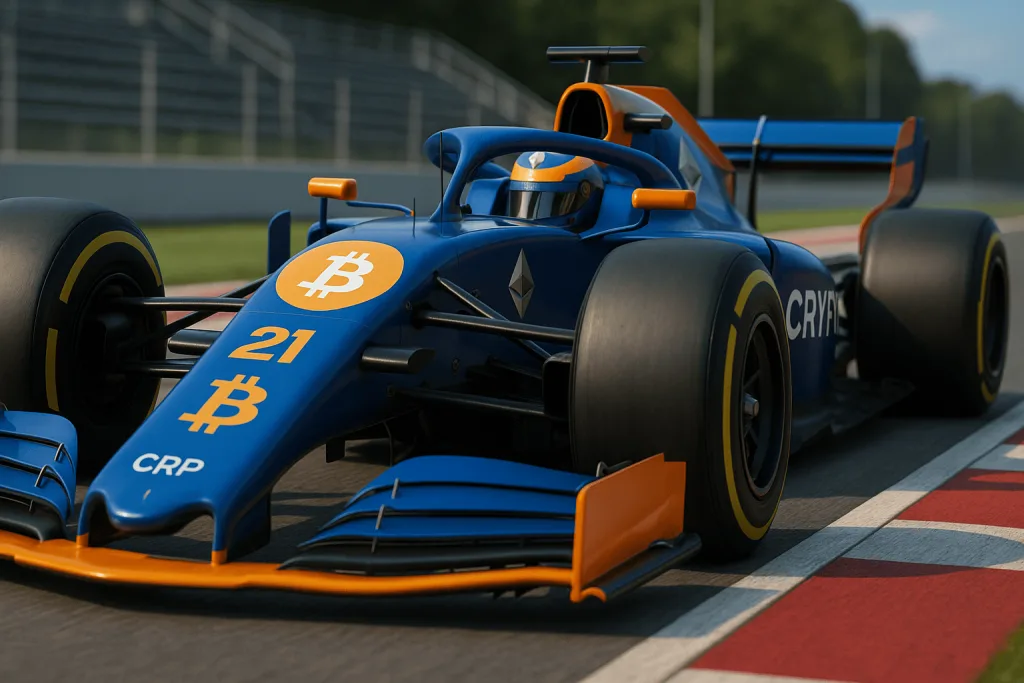
Beyond individual teams, Crypto.com remained one of the sport’s largest partners overall. The exchange signed a five-year deal with F1 in 2021 worth more than $100 million. That agreement has since been extended through 2030, securing the brand’s long-term visibility in the series. Its logo appears prominently at trackside events, fan zones, and award ceremonies.
Not every team joined the crypto wave this season. Mercedes, Racing Bulls, and Ferrari avoided crypto partnerships in 2025. However, Ferrari will enter the space soon. The team has signed a multi-year deal with BingX starting in 2026, signaling that even the most traditional teams are opening up to digital-asset sponsorships.
Interestingly, sponsorship liveries themselves are a relatively modern part of F1 history. Until the late 1960s, teams raced in simple national colors. The first commercial design came from the Gunston tobacco brand, whose gold, orange, and brown livery set the template for decades of sponsorship-driven car aesthetics.
Today, crypto companies are the newest wave shaping how F1 cars look—and how the sport funds its future.
Elon Musk’s Shift Toward Bitcoin and Energy-Backed Money
Elon Musk has always been outspoken about technology, policy, and the future of money. But his recent comments about Bitcoin show a noticeable shift in his thinking. In a viral conversation with Indian entrepreneur Nikhil Kamath, Musk argued that Bitcoin’s strength comes from its direct tie to physical energy. He explained that energy is the “true currency,” and emphasized that unlike fiat money, energy cannot be printed or legislated into existence. Generating it takes real work, real cost, and real limitations.
This moment was significant. Musk has rarely spoken about Bitcoin in recent years, yet here he openly suggested that society could move away from fiat entirely. “We probably won’t have money. We’ll just have power generation as the de facto currency,” he said.
How DOGE and Government Inefficiency Changed Musk’s View
According to Bitcoin mining advocate Daniel Batten, Musk’s evolving stance comes from firsthand experience. Batten told Cointelegraph that Musk truly believed government spending could be controlled within a fiat system. His efforts to support the Trump administration’s Department of Government Efficiency—nicknamed DOGE—were an attempt to test that belief. But the experiment failed.
Batten claims this failure helped Musk see the deeper issue: a fiat system allows unlimited money printing, making disciplined spending almost impossible. Musk, with his physics background, now appears to favor monetary systems tied to unprintable resources. Energy fits that description, which naturally leads back to Bitcoin.
The Changing Narrative Around Bitcoin Mining
Batten also noted that public perception of Bitcoin’s environmental impact is finally shifting. For years, media outlets pushed the idea that Bitcoin was harmful because of its energy use. But newer research, including Cambridge’s 2024 Digital Mining Industry Report, has debunked many of those claims.
European regulators were especially influenced by outdated metrics—like the false idea that Bitcoin consumes massive energy per transaction. Batten stresses that mining drives energy use, not the number of transactions. The network could scale dramatically without increasing energy consumption.
As these misconceptions fade, Bitcoin is increasingly viewed not as an environmental threat. However, as a viable, energy-based monetary system—one that aligns closely with Musk’s latest vision for the future.